By Mark Hayward, LMT, Certified Personal Trainer & Functional Trainer | Creating Change LLC, Clearwater, FL | 8-minute read
The short answer Tech neck and low back pain are usually two ends of the same problem. When your deep core stops stabilizing, your hips lose balance, and your upper back stiffens, your neck and low back pick up the slack. Stretching the sore spot brings short-term relief. Strengthening those three foundations is what makes the relief last.
I see this pattern every week. A client comes in for a massage because their neck is killing them. We release the tension, they feel great, and two weeks later it is back. The massage did its job. The problem is that the neck was never the root cause. It was the part of the chain that was complaining the loudest.
As both a licensed massage therapist and a certified personal and functional trainer, I get to see the problem from both sides of the table. Here is what I have learned about why posture pain keeps coming back, and what actually fixes it.
Why “Tech Neck” Is a Load Problem
Your head weighs roughly 10 to 12 pounds when it is balanced over your spine. Tilt it forward, and the load on your neck climbs quickly. A widely cited study by spine surgeon Dr. Kenneth Hansraj estimated the force on the cervical spine at about 27 pounds at a 15-degree tilt and about 60 pounds at 60 degrees, the typical angle for looking down at a phone (Hansraj, Surgical Technology International, 2014, via NPR).
Your neck muscles can handle that for a while. Hours a day, for years, is another story. And it rarely stops at the neck. As the head drifts forward, the upper back rounds, the shoulders roll in, and the low back and hips adjust to keep you upright. That is how tech neck and low back pain end up on the same bill.
The 3 Foundations I Assess First
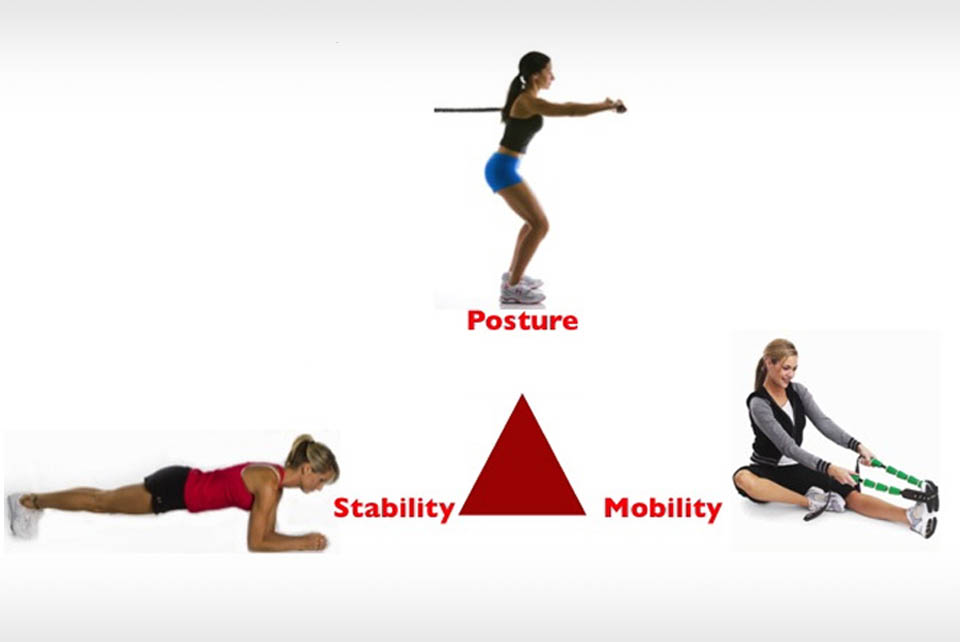
My Foundation Fitness Program is built around three phases, in this order, because each one supports the next.
1. Deep core activation
Your deep core is not your six-pack. It is a cylinder of stabilizing muscles, including the transversus abdominis, diaphragm, and pelvic floor, that create pressure inside your abdomen to protect your spine before you move.
Research by Hodges and Richardson found that in people with low back pain, the transversus abdominis was delayed in activating during movement, suggesting a breakdown in how the spine is stabilized (Hodges & Richardson, Spine, 1996). When the deep core is late to the party, bigger muscles in the back tighten up to compensate. That is a recipe for a stiff, sore low back.
2. Hip and pelvic strength and stability
Seventeen muscles cross the hip joint. When some are tight and others are weak, the pelvis tilts or rotates, and the low back has to absorb the difference. Glute weakness, tight hip flexors from sitting, and uneven stance habits are some of the most common patterns I find. The fix is not generic squats. It is identifying your specific imbalance and applying targeted corrective work to restore stability.
3. Thoracic spine and shoulder girdle integrity
Your thoracic spine (upper and mid back) is designed to rotate and extend. After years of desk work and driving, it often locks into a rounded position. When the upper back stops moving, the neck and low back move more than they should. Restoring thoracic mobility and shoulder blade control is often what finally takes pressure off the neck.
3 Starter Exercises You Can Try Today
These are gentle, beginner-friendly movements. Go slow, breathe, and stop if anything causes sharp pain.
Exercise 1: 360° core breath (deep core)
- Lie on your back with knees bent and feet flat.
- Place your hands around your lower ribs and waist.
- Inhale through your nose and feel your belly, sides, and back expand into your hands, like filling a cylinder.
- Exhale slowly and feel your deep abdominals gently draw in. Repeat for 8 to 10 breaths.
For more on how breathing affects your whole body, see Conscious Breathing.
Exercise 2: Glute bridge with a pause (hips)
- From the same position, press through your heels and lift your hips until your body forms a straight line from shoulders to knees.
- Pause for 3 seconds at the top, squeezing your glutes without arching your low back.
- Lower slowly. Do 2 sets of 10.
Exercise 3: Band pull-apart (upper back and shoulders)
- Stand tall holding a light resistance band at shoulder height, arms straight.
- Pull the band apart by squeezing your shoulder blades together and slightly down.
- Keep your chin gently tucked and ribs down. Return slowly. Do 2 sets of 12.
These are a starting point, not a program. The real value comes from an assessment that shows which of the three foundations is your weak link.
Massage + Corrective Exercise: Why the Combo Works
| Approach | What it does | Limitation on its own |
|---|---|---|
| Massage therapy | Releases tight tissue, reduces pain, improves range of motion | Relief can fade if movement patterns do not change |
| Corrective exercise | Builds strength and stability where you need it | Harder to progress when tissue is tight and painful |
| Both together | Opens a window of mobility, then trains your body to keep it | Requires a few weeks of consistency |
This is exactly why I offer both. If you are not sure which type of hands-on work fits your situation, read Medical Massage vs. Relaxation Massage. If headaches ride along with your neck tension, What Is Craniosacral Therapy? covers a gentler option. You can also browse all my massage services.
For a deeper dive into the principles behind this approach, read my earlier post, Understanding Corrective Exercise.
How the Foundation Fitness Program Works
- Three phases: deep core activation, hip and pelvic stability, then thoracic spine and shoulder girdle integrity.
- Four 1-hour sessions per phase, typically weekly (adjusted to your needs).
- Tools: resistance bands, kettlebells, dumbbells, and bodyweight exercises.
- Personalized and hands-on, with documented materials so you can practice between sessions.
- Investment: $65 per session, or $240 for a package of four.
Prefer ongoing training after the program? My functional fitness sessions build on the same foundations. And because consistency is everything, The Science of Habits shares practical ways to make new routines stick.
Frequently Asked Questions
Can posture really be corrected in adults?
Yes. Posture is largely a habit supported by strength and mobility. With targeted exercise and consistent practice, most adults can improve how they stand, sit, and move, often with less pain.
How long does it take to improve posture?
Many clients notice they feel different within the first few weeks. Lasting change typically takes a couple of months of consistent work, which is why the Foundation Fitness Program is built in three phases.
Is tech neck permanent?
For most people, no. Forward head posture usually responds well to a combination of upper back mobility, shoulder blade strength, and better daily habits. If you have numbness, tingling, or weakness in your arms, see your doctor.
Should I stretch or strengthen for low back pain?
Usually both, but strengthening is the part most people skip. Stretching a tight low back can feel good, but if the deep core and hips are not stabilizing, the tightness tends to return.
Do I need to be in shape to start the Foundation Fitness Program?
No. The program starts with deep core activation, which is gentle and accessible for almost everyone. Each phase is adjusted to your current level.
Where are sessions held?
Sessions take place inside Blue Lotus Treatment Center at 306 S. Prospect Ave., Clearwater, FL 33756, convenient for clients in Largo, Seminole, Belleair, Clearwater Beach, and Indian Rocks Beach.
Stop Chasing the Pain. Fix the Foundation.
If your neck or back keeps flaring up no matter what you try, it is time to look at the whole chain. Book online, call 727-519-8786, or learn more about Mark and how I combine bodywork with functional training.
Medical disclaimer: This article is for educational purposes and is not a substitute for medical advice. Consult your healthcare provider before starting a new exercise program, especially if you have an injury or a medical condition.
References
- Hansraj KK. Assessment of stresses in the cervical spine caused by posture and position of the head. Surgical Technology International, 2014. Summary: NPR.
- Hodges PW, Richardson CA. Inefficient muscular stabilization of the lumbar spine associated with low back pain: a motor control evaluation of transversus abdominis. Spine, 1996.